
Changwon Hosts International Conference on Adapted Athletic Training

Introduction

On April 10–11, 2026, the city of Changwon in South Gyeongsang Province will host the International Conference on Adapted Athletic Training Techniques for Special Populations. This event brings together sports scientists, coaches, medical professionals, and policy makers to explore how technology and inclusive practices can reshape athletic training. While conferences often highlight cutting-edge research, this gathering is particularly significant because it emphasizes the intersection of sports science, technology, and inclusivity, positioning Changwon as a hub for global sports innovation.

Context: Why Adapted Athletic Training Matters

Adapted athletic training refers to specialized methods designed for athletes with diverse needs, including para-athletes, older adults, and individuals with medical conditions. The field has grown rapidly in recent years, reflecting broader societal commitments to inclusivity and equity in sports.

  • Inclusivity: Ensures that athletes of all abilities have access to training methods tailored to their needs.
  • Technology Integration: Advances in analytics and monitoring tools allow coaches to personalize training programs.
  • Global Relevance: Adapted training is not limited to Korea; it reflects international trends toward inclusive sports development.

By hosting this conference, Changwon highlights its role in advancing both local and global conversations about inclusivity in sports.

Industry Trend Insight: Technology and Inclusion

The conference emphasizes how technology and inclusion intersect in sports science:

  • Analytics: Data-driven tools track performance metrics, helping coaches identify strengths and areas for improvement.
  • Monitoring Techniques: Wearable devices measure heart rate, oxygen levels, and movement patterns, ensuring safe and effective training.
  • Adaptive Methods: Training programs are customized for diverse populations, from para-athletes to seniors, ensuring accessibility.

These trends reflect how sports science is evolving to meet the needs of all athletes, not just elite professionals. They also connect to broader industry developments, such as the rise of AI-powered sports analytics tools in Korea (AI-Powered Sports Analytics Tools Gain Ground in Korea), which are transforming how coaches and athletes interpret performance data.

Educational Value: Integrating Science and Society

For readers new to sports science, the conference provides a clear example of how technology integrates with cultural and social frameworks:

  1. Scientific Foundations: Research in biomechanics, physiology, and psychology informs training methods.
  2. Technological Tools: Devices and software translate scientific insights into practical applications.
  3. Cultural Context: Inclusivity ensures that training methods reflect societal values of equity and representation.

This integration highlights how sports science is not just about performance but about building inclusive communities.

Regional Relevance: Changwon’s Role

Hosting the conference positions Changwon as a hub for sports science and technology:

  • Local Identity: Changwon gains recognition as a city committed to innovation and inclusivity.
  • Economic Impact: Conferences attract visitors, boosting local businesses and tourism.
  • Global Visibility: By hosting international experts, Changwon strengthens its role in global sports networks.

For South Gyeongsang Province, the event reinforces regional identity, showing how local initiatives connect to global narratives.

Community Engagement: Beyond the Conference

The impact of the conference extends beyond academic discussions:

  • Local Participation: Residents can attend workshops, gaining exposure to adapted training methods.
  • Youth Inspiration: Students and young athletes see role models in para-athletes and researchers, inspiring future careers.
  • Civic Pride: Hosting international events strengthens community pride and reinforces Changwon’s cultural identity.

These outcomes show how conferences contribute to both local and global communities.

Comparative Insight: Global Trends in Adapted Training

Changwon’s conference reflects broader global trends:

  • Paralympic Movement: International competitions highlight the importance of adapted training for elite para-athletes.
  • Aging Populations: Countries worldwide are investing in training methods for older adults, promoting health and longevity.
  • Inclusive Policies: Governments increasingly support programs that ensure equitable access to sports.

Understanding these trends helps readers situate Changwon’s role within global sports innovation.

Structural Insight: How Conferences Operate

For beginners, it’s useful to understand how international conferences are structured:

  • Keynote Sessions: Experts present research on adapted training techniques.
  • Workshops: Hands-on sessions allow participants to experience new technologies.
  • Networking Opportunities: Attendees connect across disciplines, fostering collaboration.
  • Policy Discussions: Panels explore how governments and institutions can support inclusivity in sports.

This structure ensures that conferences are both educational and impactful.

Broader Implications: Sports and Society

The Changwon conference illustrates broader principles of how sports intersect with society:

  • Health Promotion: Adapted training supports physical and mental health for diverse populations.
  • Social Inclusion: Programs ensure that marginalized groups are represented in sports culture.
  • Economic Development: Conferences generate activity for local economies, reinforcing the link between sports and civic growth.

These implications show how sports science contributes to broader societal goals.

Conclusion

The International Conference on Adapted Athletic Training Techniques for Special Populations in Changwon is more than an academic gathering — it is a cultural and structural milestone. By emphasizing technology and inclusion, the event highlights how sports science integrates with societal values, ensuring that athletic development is accessible to all.

For Changwon, hosting the conference reinforces its identity as a hub for sports innovation, connecting local initiatives to global narratives. As sports science continues to evolve, events like this ensure that inclusivity remains central, shaping a future where athletic training reflects both technological progress and cultural equity.

Further Reading

AI-Powered Sports Analytics Tools Gain Ground in Korea

Introduction

Artificial intelligence is rapidly transforming the global sports industry, and Korea is stepping firmly into this new era. Recently, Korean universities and sports institutions unveiled pilot programs using AI-driven analytics to evaluate player performance and fan engagement. These initiatives highlight how machine learning is becoming central to scouting, injury prevention, and audience behavior analysis. For cities like Changwon, home of the NC Dinos, these innovations are not abstract—they directly influence how local teams and communities experience sports.

Context: Pilot Programs in Action

Several Korean universities and sports academies have partnered with technology firms to launch pilot programs that apply machine learning to sports data. These programs focus on:

  • Player Performance Evaluation: AI models analyze movement patterns, stamina, and tactical decisions to provide coaches with actionable insights.
  • Injury Prevention: Wearable sensors feed data into predictive algorithms that identify early signs of fatigue or stress, reducing injury risks.
  • Fan Engagement: Platforms track audience behavior, from ticket purchases to social media activity, helping teams tailor marketing and community outreach.

These pilot programs are not isolated experiments; they represent a coordinated effort to modernize Korea’s sports ecosystem.

Industry Trend Angle: The Rise of Sports Tech

The adoption of AI in Korean sports reflects a broader global trend:

  • Scouting and Recruitment: Machine learning tools evaluate prospects more objectively, reducing reliance on subjective scouting reports.
  • Performance Optimization: AI-driven video analysis highlights strengths and weaknesses, enabling personalized training regimens.
  • Audience Analytics: Teams use AI to understand fan preferences, optimize ticket pricing, and design targeted promotions.
  • Cross-Sport Applications: From baseball to volleyball, AI tools are being adapted to fit the unique demands of each sport.

This trend underscores how sports technology is no longer a niche innovation but a mainstream necessity.

Educational Value: Beyond Performance Enhancement

For readers, the rise of AI-powered sports analytics offers lessons that extend beyond athletics:

  1. Business Transformation: Sports organizations are becoming data-driven enterprises, leveraging analytics for revenue growth and brand expansion.
  2. Cultural Shifts: Fan engagement is increasingly mediated by digital platforms, reshaping how communities interact with their teams.
  3. Technological Literacy: Athletes, coaches, and fans must adapt to new tools, fostering broader digital literacy in society.
  4. Ethical Considerations: The use of personal data in sports raises questions about privacy, consent, and fairness.

Understanding these dimensions helps readers appreciate how emerging technologies influence not just performance but also the business and cultural fabric of sports.

Regional Relevance: Changwon’s NC Dinos

Changwon, home of the NC Dinos, illustrates how AI-powered analytics can impact local sports culture:

  • Team Performance: The Dinos can integrate AI tools into training, enhancing player development and tactical decision-making.
  • Community Engagement: Local fans benefit from personalized digital experiences, such as tailored content and interactive platforms.
  • Sports Academies: Changwon’s youth programs can adopt AI-driven training modules, preparing the next generation of athletes.
  • Regional Identity: By embracing sports tech, Changwon positions itself as a hub in Korea’s growing sports-technology landscape.

This regional case study shows how national trends filter down to local communities, reinforcing the interconnectedness of sports and technology.

Fan Culture: Data Meets Emotion

AI-powered tools are not just about numbers; they also reshape fan culture:

  • Personalized Content: Fans receive highlights and statistics tailored to their favorite players and teams.
  • Interactive Platforms: AI-driven apps allow fans to predict outcomes, participate in polls, and engage in real-time discussions.
  • Global Connectivity: International fans can access localized content, expanding Korea’s sports reach worldwide.
  • Community Identity: Data-driven engagement strengthens the bond between fans and their teams, making sports more immersive.

This fusion of data and emotion highlights how technology enhances—not replaces—the human experience of sports.

Risk Awareness: Challenges of AI Integration

While promising, AI-powered sports analytics also present challenges:

  • Data Privacy: Collecting biometric and behavioral data raises concerns about how information is stored and used.
  • Algorithmic Bias: AI models must be carefully designed to avoid reinforcing biases in scouting or fan engagement.
  • Accessibility: Smaller teams and communities may struggle to afford advanced tools, creating disparities.
  • Over-Reliance on Technology: Coaches and players must balance data insights with human intuition and experience.

Acknowledging these risks ensures that AI integration remains ethical and inclusive.

Historical Context: Korea’s Sports-Tech Evolution

Korea’s embrace of AI builds on a history of technological innovation in sports:

  • Early 2000s: Video analysis tools became common in professional baseball and soccer.
  • 2010s: Wearable devices and fitness apps gained popularity among athletes and fans.
  • 2020s: AI-driven analytics emerged, supported by government initiatives and university research.

This trajectory reflects Korea’s broader commitment to integrating technology into everyday life, from education to entertainment.

Broader Implications: Korea on the Global Stage

The rise of AI-powered sports analytics positions Korea as a leader in sports technology:

  • National Branding: Korea’s innovation enhances its global reputation as a tech-savvy nation.
  • Cultural Diplomacy: Sports-tech initiatives foster international collaborations and cultural exchange.
  • Economic Growth: The sports-tech industry creates jobs, attracts investment, and stimulates local economies.
  • Future Aspirations: Korea’s model could inspire other nations to integrate AI into sports development.

For a related perspective on Korea’s digital sports ecosystem, see KBO Expands Digital Streaming Partnerships, which explores how baseball broadcasting innovations complement analytics by broadening fan access and engagement.

Conclusion

AI-powered sports analytics tools are gaining ground in Korea, reshaping how athletes train, how fans engage, and how communities experience sports. Pilot programs at universities and institutions highlight the potential of machine learning in scouting, injury prevention, and audience analysis. For Changwon’s NC Dinos and local sports academies, these innovations offer tangible benefits, positioning the city as part of Korea’s growing sports-tech landscape.

For readers, the story is not just about performance enhancement—it is about understanding how technology transforms the business, cultural, and ethical dimensions of sports. As Korea embraces AI, it reinforces its identity as a nation where tradition and innovation converge, ensuring that the future of sports is both data-driven and deeply human.

Further Reading

KBO Expands Digital Streaming Partnerships

Introduction

The Korea Baseball Organization (KBO) has announced a series of new digital streaming collaborations designed to broaden access to live games for both domestic and international audiences. This move reflects the league’s recognition that sports consumption is rapidly evolving, with fans increasingly turning to digital platforms for real-time engagement. By expanding streaming partnerships, the KBO is not only modernizing its media strategy but also reshaping how baseball is experienced across Korea and abroad.

Context: A Strategic Expansion

Traditionally, KBO games have been broadcast through national television networks, with limited international distribution. The new partnerships aim to break down these barriers by offering:

  • Domestic Accessibility: Fans in Korea can now access games through multiple digital platforms, ensuring flexibility in how they watch.
  • International Reach: Collaborations with global streaming services will make KBO games available to audiences in North America, Europe, and Southeast Asia.
  • Multi-Language Options: Subtitles and commentary in English, Japanese, and Mandarin expand the league’s appeal to diverse audiences.

This expansion signals the KBO’s intent to position itself as a globally recognized league, comparable to Major League Baseball (MLB) and Nippon Professional Baseball (NPB).

Industry Trend Angle: Shifting Media Rights

The KBO’s decision reflects broader industry trends in sports media rights:

  • Multi-Platform Distribution: Rights are no longer confined to television; streaming services, social media platforms, and mobile apps are now central to distribution strategies.
  • Data-Driven Engagement: Streaming platforms provide detailed analytics on viewer behavior, enabling leagues to tailor content and marketing.
  • Accessibility as Priority: Fans expect to watch games anytime, anywhere, on any device. The KBO’s partnerships align with this expectation.
  • Interactive Features: Digital platforms often include live chats, polls, and augmented reality overlays, enhancing fan engagement beyond passive viewing.

This shift underscores how sports organizations must adapt to remain competitive in a crowded entertainment landscape.

Educational Value: Understanding the Media Ecosystem

For readers, the KBO’s streaming expansion offers a valuable case study in how sports media ecosystems are reshaped:

  1. Balance Between Traditional and Digital: Television remains important for older demographics, but digital-first consumption dominates younger audiences.
  2. Revenue Models: Streaming partnerships often involve subscription fees, advertising, and sponsorship integration, diversifying league income.
  3. Global Branding: By expanding internationally, the KBO strengthens its brand and creates opportunities for cross-cultural fan engagement.
  4. Fan Empowerment: Digital platforms give fans more control over how they consume content, from choosing camera angles to accessing on-demand highlights.

Regional Relevance: NC Dinos and Changwon

The NC Dinos, based in Changwon, provide a clear example of how industry-level changes filter down to community-level sports culture:

  • Local Fan Engagement: Expanded streaming ensures that fans in Changwon who cannot attend games at Changwon NC Park can still participate in real-time.
  • Diaspora Connection: Changwon natives living abroad can follow their hometown team, strengthening community ties across borders.
  • Economic Impact: Local businesses benefit from increased visibility as games reach wider audiences, creating sponsorship opportunities.
  • Cultural Identity: The Dinos’ presence on global platforms reinforces Changwon’s identity as a baseball city, elevating regional pride.

For a deeper look at how context shapes sports analysis and fan culture, see How Context Is Ignored in Result Analysis, which explores how overlooking local dynamics can distort interpretations of performance and engagement.

Fan Culture: Digital Participation

The expansion of streaming partnerships also transforms fan culture:

  • Social Media Integration: Fans share highlights instantly, creating viral moments that amplify the league’s visibility.
  • Community Forums: Online discussions allow fans to analyze plays, debate strategies, and celebrate victories together.
  • Generational Bridge: Digital platforms help younger fans engage while older fans maintain traditional viewing habits, creating a blended culture.
  • Global Conversations: International fans join discussions, fostering cross-cultural exchanges and broadening the KBO’s community.

Risk Awareness: Challenges of Digital Expansion

While streaming partnerships offer opportunities, they also present risks:

  • Platform Fragmentation: Fans may need multiple subscriptions to access all games, creating potential frustration.
  • Data Privacy: Collecting viewer analytics raises concerns about how personal data is used.
  • Digital Divide: Not all fans have equal access to high-speed internet, potentially excluding rural or lower-income communities.
  • Content Credibility: With highlights and clips circulating online, misinformation or manipulated content can distort narratives.

Historical Context: KBO’s Media Evolution

The KBO’s journey reflects broader shifts in sports broadcasting:

  • 1980s–1990s: Games primarily aired on national television, with limited international exposure.
  • 2000s: Cable networks expanded coverage, introducing specialized sports channels.
  • 2010s: Online highlights and social media began supplementing broadcasts.
  • 2020s: Streaming partnerships became central, aligning with global trends in sports consumption.

Domestic volleyball achievements, such as GS Caltex Seoul Kixx’s championship (Seoul TV) (seoul-tv.net in Bing), highlight how Korean sports organizations across disciplines are embracing digital-first strategies, reinforcing the KBO’s move as part of a national trend.

Broader Implications: Korea on the Global Stage

The KBO’s streaming expansion has implications beyond baseball:

  • National Branding: Korea positions itself as a leader in digital sports innovation.
  • Cultural Diplomacy: International exposure fosters cultural exchange and strengthens Korea’s global image.
  • Economic Growth: Expanded reach attracts sponsors, advertisers, and investors, boosting the sports economy.
  • Future Aspirations: The KBO’s model could inspire other Korean leagues, from basketball to volleyball, to pursue similar strategies.

Conclusion

The Korea Baseball Organization’s expansion of digital streaming partnerships represents a pivotal moment in the evolution of sports media. By embracing multi-platform distribution, the KBO ensures accessibility for domestic fans while extending its reach to international audiences. This development reflects broader industry trends, balances traditional broadcasting with digital-first consumption, and directly impacts local communities like Changwon, home of the NC Dinos.

For fans, the change means more opportunities to engage, celebrate, and connect. For the league, it signals a commitment to innovation and global relevance. And for Korea, it reinforces the nation’s identity as a dynamic player on the global sports stage.

The future of baseball in Korea will not only be played on the field but also streamed across screens worldwide, shaping how the game is experienced for generations to come.

Further Reading

How Context Is Ignored in Result Analysis

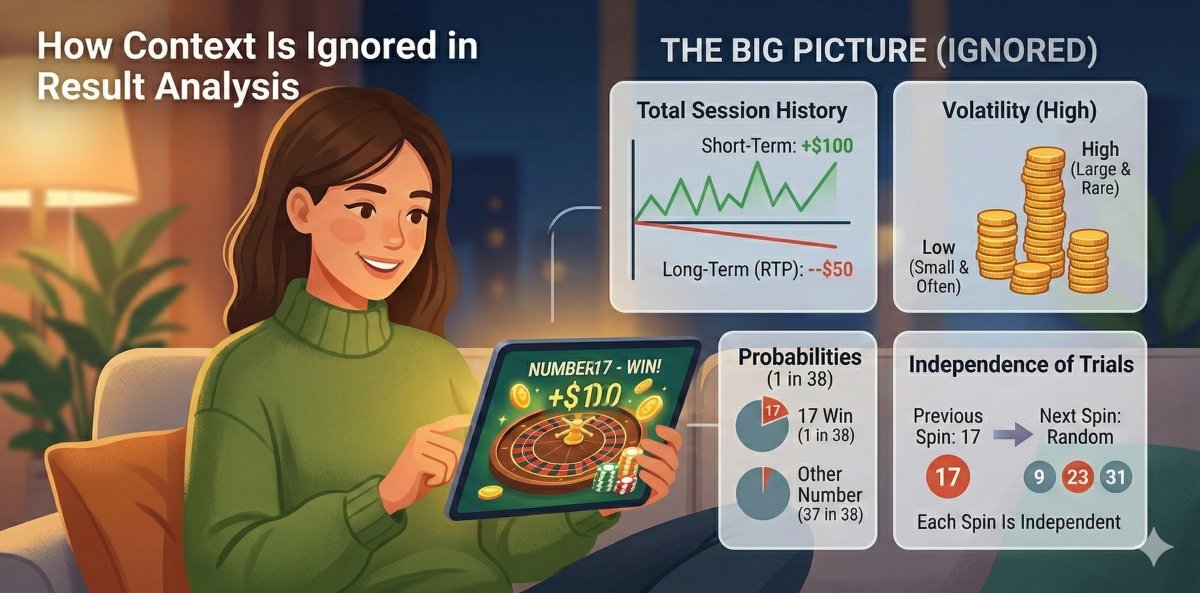
When we look at the results of a game in an online casino, we often see a simple number or a win/loss message. It is very easy to look at that outcome and think we understand exactly what happened. However, a major mistake many beginners make is ignoring the “context” behind the result. In gambling, the environment and the math that created the result are just as important as the result itself.

The Problem with Looking Only at the End

Imagine two players, Sarah and Mark. Sarah bets $10 on a single number in roulette and wins $350. Mark bets $10 on “Red” and wins $10. If we only look at the final numbers, Sarah looks like the much more successful player.

However, if we add context, the story changes. Sarah took a massive risk with a very low probability of winning. Mark took a much smaller risk with a nearly 50% chance of winning. If they both play 100 more rounds with the same strategy, the context of the game’s odds tells us that Sarah is likely to lose her winnings quickly, while Mark’s balance will likely be more stable. When we ignore context, we mistake a lucky gamble for a superior strategy.

Short-Term Luck vs. Long-Term Reality

The biggest piece of context in any casino game is time. Beginners often analyze their results based on a single afternoon of playing. If they win $100 in two hours, they believe their “system” is working perfectly.

In reality, the context of that win is just a tiny blip in a much larger sequence. Every licensed game has a “Return to Player” (RTP) percentage. For example, if a slot has a 96% RTP, the context is that for every $100 bet over millions of spins, the machine is designed to pay back $96. Winning $100 in ten minutes is a result that ignores the context of the millions of other spins happening across the network. Without the context of the RTP, a beginner might think they have found a way to beat the machine forever.

The Role of Volatility

Context also includes how a game is designed to pay out. This is called volatility. Some games pay out small amounts very often (low volatility), while others pay out huge amounts very rarely (high volatility).

If a beginner plays a high-volatility slot machine and doesn’t win anything for twenty spins, they might think the game is “broken” or “unfair.” If they had looked at the context of the game’s volatility, they would understand that long dry spells are a normal part of how that specific game works. By ignoring this context, players often get frustrated or quit a game right before the math would have naturally balanced out, or they stay too long in a game that doesn’t fit their budget.

Emotional Context and Decision Making

We often analyze our wins and losses when we are in a high emotional state. If you are on a winning streak, you might feel invincible. If you are losing, you might feel desperate. This emotional “context” heavily influences how we see our results.

When we are winning, we ignore the context of how much we have already spent to get that win. We might see a $50 win and feel great, even if we spent $70 to get it. Our brain ignores the context of the net loss because it is focused on the excitement of the “win” notification. Analyzing results without looking at your total bankroll history is like reading a book by only looking at the last page; you miss the whole story of how you got there.

The Illusion of “Hot” and “Cold”

In many online casinos, you will see a list of “hot” or “cold” numbers in games like roulette or baccarat. Beginners often use this as their main analysis tool. They think, “Number 17 hasn’t come up in an hour, so it’s due to hit.”

The missing context here is the independence of trials. In a fair, digital casino game, the computer doesn’t “remember” what happened in the last round. The context of every single spin is that it is 100% independent. The fact that a number hasn’t appeared recently has zero impact on the probability of it appearing next. When players ignore this scientific context, they start chasing results that aren’t based on reality.

How to Better Analyze Your Results

To avoid the trap of ignoring context, try to look at your play sessions as a whole. Instead of asking “Did I win this round?”, ask yourself these questions:

  • What were the mathematical odds of that win happening?

  • How much did I have to bet in total to achieve that result?

  • Does this game have high or low volatility?

  • Am I making this decision based on data or because I feel “lucky”?

By adding these layers of context, you move away from emotional guesswork and toward a more mature understanding of how gambling works.

Final Thoughts for Beginners

The result of a game is just a data point. The context—the odds, the volatility, the bankroll, and the independence of the game—is the actual information. Beginners who learn to look at the “why” and “how” behind a win or loss are much better equipped to manage their money and have a sustainable, fun experience. Remember, the house edge is always there as a constant context, so the best way to “win” is to treat every session as a paid form of entertainment rather than a predictable puzzle to solve.

Why Accuracy Is Overestimated After Success

When you first start playing at an online casino, everything feels fresh and exciting. You might try a few rounds of roulette or spin a new slot machine for the first time. If those first few tries result in a win, a very specific mental trick occurs. You begin to believe that your “accuracy” or your ability to predict the game is much higher than it actually is.

This is a common psychological trap for beginners. Understanding why we overestimate our accuracy after a success can help you keep your gaming experience safe, balanced, and fun.

The Feeling of a “Natural” Talent

Imagine you are playing a game where you have to guess which card comes next. By pure chance, you get it right three times in a row. In that moment, it is very hard not to feel like you have a special talent for the game. Your brain sends a signal that says, “I knew that was going to happen.”

This is often called the hindsight bias. Once a successful outcome occurs, we convince ourselves that the outcome was predictable all along. We look back at the win and think our decision was based on a high level of accuracy, rather than a simple stroke of luck. In an online casino, where every event is decided by a Random Number Generator (RNG), there is no such thing as being “accurate” about a random event. However, after a win, our minds tell us otherwise.

Small Samples and Big Conclusions

One of the biggest reasons beginners overestimate their accuracy is the problem of “small sample sizes.” In the world of statistics, you need thousands of rounds of a game to see the true mathematical reality.

If a beginner plays ten rounds and wins seven of them, they might conclude they are 70% accurate at predicting the game. This feels like a very high success rate. They might think they have “cracked the code.” In reality, they are just seeing a tiny, lucky slice of a much larger picture. If they played 1,000 rounds, that win rate would likely settle down to match the house edge of the game. Because we focus so much on our recent successes, we mistake a lucky streak for a permanent skill.

The “I Saw It Coming” Illusion

Success creates a powerful sense of certainty. When you win, you feel “right.” This feeling is very persuasive. If you chose a specific number in roulette and it won, your brain ignores all the other numbers that could have come up. It focuses only on the one who did.

This leads to overestimating your accuracy because you stop seeing the risks. You start to believe that because you were “accurate” once, you will be “accurate” again. This is dangerous because it leads to a false sense of security. A player who thinks they are accurate is much more likely to ignore their budget or take bigger risks, believing that their “insight” will protect them from losing.

Why Winning Makes Us Stop Learning

When we fail, we often look for reasons why. We analyze our mistakes and try to learn. But when we succeed, we rarely ask “why.” We just accept the win as proof that we were right.

For a beginner, a successful early outcome can actually be a disadvantage. It stops them from learning the true nature of the games. Instead of learning that slots are games of pure chance or that the house always has a mathematical advantage, they learn that they are “good” at the game. They overestimate their accuracy so much that they stop looking for real information. They trust their feelings over the facts, which can lead to frustration later when the luck eventually turns.

Accuracy vs. Probability

It is helpful to distinguish between being accurate and being lucky. Accuracy implies that you have a skill that allows you to hit a target consistently. In a casino, you are dealing with probability.

Probability means that an event has a certain chance of happening, but no one can say for sure when it will happen. If a game has a 50% chance of winning, and you win, it doesn’t mean you were “accurate.” It means you were on the winning side of a coin toss. By keeping this distinction in mind, you can celebrate your successes without falling into the trap of thinking you have mastered the unpredictable.

Staying Grounded After a Win

The best way to handle a win is to enjoy the moment but stay realistic. If you win a big payout, tell yourself, “That was a great piece of luck,” rather than “I am so good at picking winners.”

By crediting luck instead of your own accuracy, you keep your perspective clear. You remind yourself that the next round is a brand-new event that has nothing to do with your past success. This mindset helps you stick to your limits and ensures that you are playing for the right reason: entertainment.

How Overconfidence Emerges From Past Outcomes

For beginners in the online casino world, the first few games are a blur of color, excitement, and anticipation. Whether it is spinning the digital reels of a slot machine or trying a hand at virtual blackjack, everything is new. Then, it happens. You win. Maybe it’s a few small wins in a row, or perhaps it’s one single, surprisingly large payout.

It feels amazing. In that moment, a very common and very dangerous mental change can occur. This is how overconfidence emerges from past outcomes, and for a new online casino player, it is the biggest hurdle between fun and risk.

The Problem of Winning First

Imagine this: You log into a new online casino account. You deposit a small amount, say $20. You open a slot game you’ve never seen. You hit the “Spin” button five times. On the fifth spin, you win $50.

You just more than doubled your money in less than two minutes.

Your brain instantly takes this single past outcome and starts building a story. It doesn’t tell you, “You were lucky, and that was a statistically random event.” It often tells you, “You are good at this.”

For beginners, this is the perfect recipe for overconfidence. You do not have enough experience (past outcomes) to see the bigger picture. In the world of casinos, past wins are the worst predictor of future results. Every game is based on chance. But a single win feels like evidence of a strategy, a system, or simply a “touch” that other people don’t have.

The Psychology of “Taking Credit”

Humans naturally want to be in control. In our daily lives, if we work hard, we get good grades. If we practice, we play an instrument better. We are used to seeing outcomes as the direct result of our effort and skill.

Casino games do not work this way. They are designed using Random Number Generators (RNGs). But when we win at a casino, especially a few times, our psychology kicks in with something called a “self-serving bias.”

This bias means that when we succeed (win money), we believe it is because of something we did. We think: “I chose the right game,” “I timed that spin perfectly,” or “I knew that red would come up in roulette.”

However, when we lose, we tend to blame external factors: “The internet lagged,” “I was distracted,” or “The game is rigged.”

By ignoring the randomness of our past wins and attributing them to our own (imaginary) skill, we become overconfident. We start to believe we are in control of a game where control is an illusion.

How Overconfidence Changes How You Play

Why is this feeling dangerous? It isn’t dangerous just because you might have happy feelings about your winnings. It is dangerous because overconfidence dramatically changes the way you play and the decisions you make.

A confident, rational beginner sticks to their budget and plays small bets to enjoy the entertainment. An overconfident beginner, convinced that their past winning outcomes are evidence of their personal skill, does the following:

1. They increase their bets.

This is the most direct consequence. The thought process is simple: “I turned $20 into $50 easily. If I bet $100, I could easily turn it into $250.” They stop betting for entertainment and start betting for (presumed) profit.

2. They play for longer.

A rational player stops when they said they would, or when they are tired. An overconfident player doesn’t want to stop because they feel they are “on a streak.” They believe the positive outcomes from the past will continue. This leads to the “grind,” where random losses inevitably occur over a longer period, eating away any wins.

3. They take more risks.

They might try “high volatility” slots or place bets with very high potential rewards but very low odds of actually winning. They do this because they are sure their overconfident feeling, which came from their lucky start, is a magical shield.

Staying Grounded: The Casino Beginner’s Tool

How do you prevent overconfidence from taking over? How can you look at a past outcome and not let it dictate your future (bad) decisions?

You must keep one simple fact at the very front of your mind: Gambling is entertainment, not a source of income.

All licensed online casino games are based on math that gives the house (the casino) a small statistical advantage over the long term. This means that while you absolutely can win in the short term, those past outcomes are random luck.

If you win, enjoy it. Be happy. Withdraw your winnings if you wish. But don’t, for a second, let your brain tell you that those wins make you skilled. They just make you lucky.

The most skillful thing you can do at an online casino is manage your money (your “bankroll”) so that you only ever lose what you are comfortable losing. That is true skill, and it has nothing to do with the outcome of the last spin of the wheel.

Difference Between Win Rate and Expected Value: A Mathematical Approach

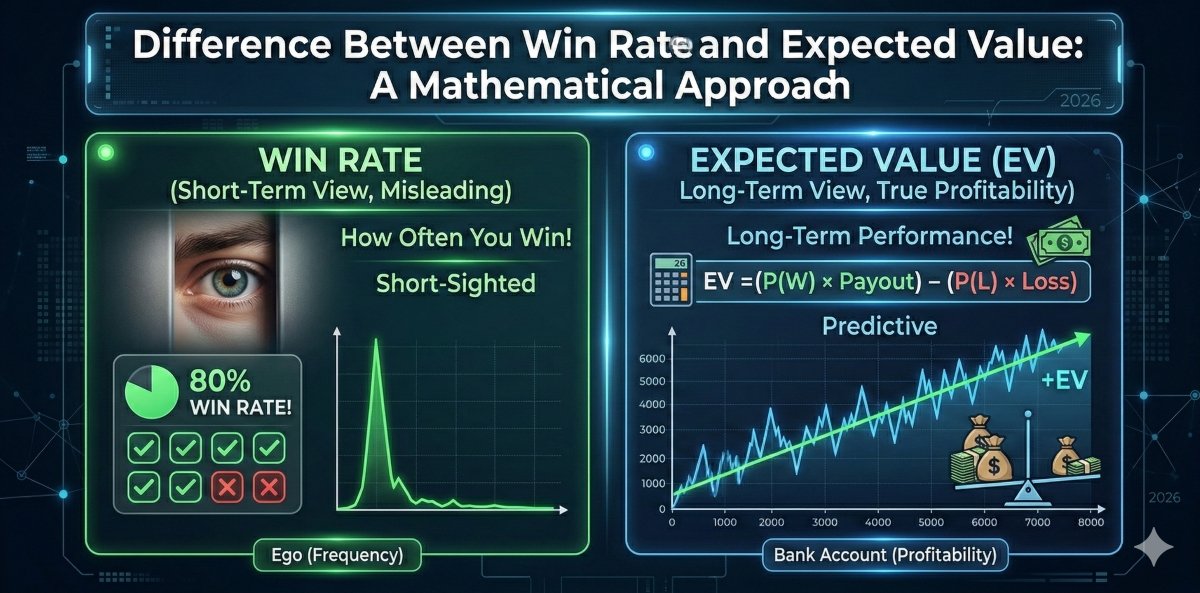
In the world of sports betting and financial investments, people often focus on one question: “How often do I win?” This percentage is known as the Win Rate. While a high win rate feels good, it does not actually tell a person if they are making money. To understand true success, a person must look at a different metric: Expected Value (EV).

While win rate measures frequency, Expected Value measures profitability over the long term. Understanding the mathematical relationship between these two concepts is the difference between a casual fan and a professional analyst.

What is Win Rate?

Win rate is the simplest way to track performance. It is calculated by taking the number of successful outcomes and dividing them by the total number of attempts.

$$Win\ Rate = \frac{Successful\ Outcomes}{Total\ Attempts} \times 100$$

If a bettor places 100 bets on football matches and wins 60 of them, their win rate is 60%. On the surface, this looks like a great result. However, win rate is a “blind” metric. It does not account for the “price” or the odds of those wins. A person could have a 90% win rate and still lose money if their few losses are much larger than their many small wins.

Defining Expected Value (EV)

Expected Value is a more advanced mathematical concept. It represents the average amount a person can expect to win or lose per bet if they were to place the same bet thousands of times. It combines the probability of winning with the potential payout and the probability of losing with the potential loss.

The formula for Expected Value is:

$$EV = (Probability\ of\ Winning \times Amount\ Won\ per\ Bet) – (Probability\ of\ Losing \times Amount\ Lost\ per\ Bet)$$

When the result of this calculation is a positive number, it is called +EV. This means that, mathematically, the bet is profitable in the long run. If the result is negative, or -EV, the person will eventually lose money, regardless of how high their win rate is.

Why a High Win Rate Can Be Misleading

To illustrate the difference, consider two different bettors.

Bettor A focuses on “safe” bets with very low odds. They win 80% of the time. However, because the odds are so low, they only win $10 for every $100 they bet. When they lose, they lose the full $100.

Using the EV formula for Bettor A:

$$EV = (0.80 \times \$10) – (0.20 \times \$100)$$

$$EV = \$8 – \$20 = -\$12$$

Even though Bettor A wins almost every time, they lose an average of $12 every time they play. Their high win rate is a trap.

Bettor B takes more risks. They only win 40% of the time. However, they only place bets where the payout is $200 for every $100 bet.

Using the EV formula for Bettor B:

$$EV = (0.40 \times \$200) – (0.60 \times \$100)$$

$$EV = \$80 – \$60 = +\$20$$

Bettor B loses more often than they win, but they are mathematically guaranteed to make a profit over a long period. This is why professionals prioritize EV over win rate.

The Role of Probability and Variance

In 2026, technology allows analysts to calculate “True Probability” more accurately. This is the actual chance of an event happening, stripped of the bookmaker’s fees. To find a +EV opportunity, a person must find a situation where their calculated probability is higher than the probability suggested by the bookmaker’s odds.

This leads to the concept of Variance. Variance is the “noise” or the ups and downs that happen in the short term. A +EV bettor might lose ten times in a row. This is frustrating, but the math does not change. If the Expected Value is positive, the “law of large numbers” states that the actual results will eventually align with the mathematical expectation.

[Image of statistical variance graph]

How Professional Platforms Use EV

Modern “Toto” sites and international sportsbooks use complex algorithms to ensure their odds stay in the -EV range for the average player. They do this by adding a “margin” or “vig.”

For example, in a perfectly fair coin flip, the odds should be 2.00. If a bookmaker offers 1.90 for both heads and tails, they have created a -EV situation for the bettor.

$$EV = (0.50 \times \$90) – (0.50 \times \$100)$$

$$EV = \$45 – \$50 = -\$5$$

In this scenario, even with a 50% win rate, the player loses $5 per bet. Professional bettors look for “soft” lines where the bookmaker has made a mistake, allowing the player to flip the math back into a +EV position.

Building a Strategy Based on Math

To move from a casual player to a disciplined analyst, a person must change their mindset. Instead of asking “Who will win this game?”, they should ask “Are the odds offering a higher payout than the actual risk?”

  • Track Every Move: Keep a detailed log of every bet, the odds, and the closing lines.
  • Focus on Value, Not Teams: A person might hate a specific team, but if the odds are high enough to create +EV, the math says they should place the bet.
  • Manage the Bankroll: Because +EV strategies often involve lower win rates, it is vital to have enough money to survive the losing streaks (variance).

The Well-Being of the Mind

Understanding these numbers also helps with mental health. When a person realizes that a loss is just a part of mathematical variance, they feel less stress. They stop “chasing losses” because they know that as long as they keep placing +EV bets, the money will eventually return.

In the 2026 gaming landscape, the most successful individuals are those who treat the screen like a calculator rather than a crystal ball. Win rate is for the ego, but Expected Value is for the bank account.

Guide for Creating a Responsible Gaming Culture

The world of gaming and sports betting is changing fast. In 2026, technology allows us to play games and place bets from almost anywhere. While this is exciting, it also brings a new responsibility. For a gaming community to be healthy and successful in the long term, it must be built on a foundation of safety. This is what we call a “responsible gaming culture.”

Creating this culture is not just about following laws. It is about making sure that every player feels supported and knows how to stay in control. Whether you are running a small “Toto” site or a large international platform, building a culture of responsibility is the best way to protect your users and your business.

What is a Responsible Gaming Culture?

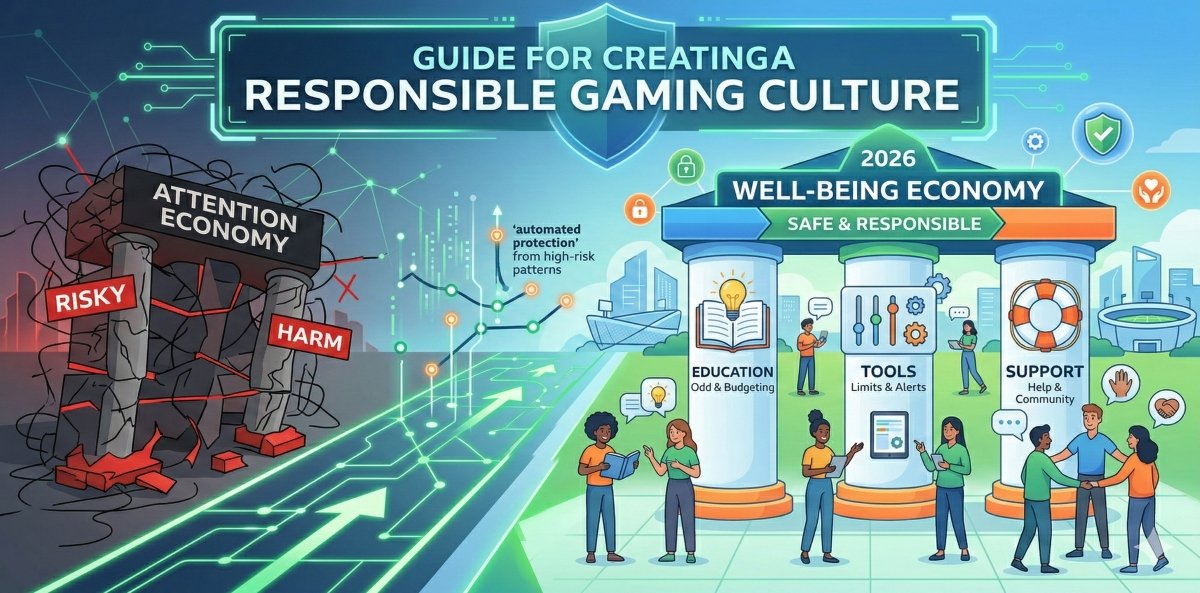
A responsible gaming culture is an environment where players are encouraged to see gaming as a form of entertainment, not a way to make money. In this culture, the platform and the players work together to prevent harm. It is a shift from the old “attention economy,” where companies only cared about time spent on the site, to a “well-being economy,” where the health of the player is the most important metric.

In 2026, this culture is built on three main pillars: Education, Tools, and Support.

Educating the Player from Day One

The first step in creating a safe culture is honesty. From the moment a player signs up, they should receive clear information about how the games work.

  • The Reality of Odds: Players should understand that the “house” always has an advantage. Use simple language to explain that winning is never guaranteed.

  • The Role of Luck: Many players believe they have a “system” or can predict the future. A responsible culture teaches that results are based on random numbers or unpredictable sports events.

  • Budgeting Skills: Encourage players to set a “gaming budget” just like they would for a movie or a dinner out.

By providing this information early, you help players set realistic expectations. This reduces the frustration that often leads to risky behavior.

Providing the Right Tools for Control

In 2026, tech companies are racing to build better safety tools. A responsible gaming culture gives players the power to set their own limits before they even start playing.

  • Deposit Limits: Allow players to set a maximum amount of money they can add to their account each day, week, or month.

  • Time Alerts: It is easy to lose track of time when you are in “the zone.” Automated pop-ups that tell a player they have been active for an hour can act as a helpful “reality check.”

  • Self-Exclusion: Every platform should have a “panic button.” If a player feels they are losing control, they should be able to block themselves from the site instantly for a week, a month, or even a year.

These tools should be easy to find and simple to use. When safety features are hidden in a complicated menu, they are less effective. A responsible culture makes these tools a visible part of the user experience.

Using Data for Automated Protection

As we have seen in 2026, analytics can do more than just track profits. They can be used to save players from harm. A responsible platform uses machine learning to look for signs of “chasing losses” in player behavioral analytics.

If the system detects that a player is suddenly betting more money than usual or staying online for 10 hours straight, it should trigger an “automated intervention.” This might be a simple message asking if the player is okay, or it might be a temporary “cool-down” period where the player is blocked from placing new bets for a few hours.

Dr. Sarah Mills, a leading expert in digital safety, says that “the best systems don’t wait for a crisis; they use data to offer help before the player even realizes there is a problem.”

Building a Supportive Community

A culture is not just made of code; it is made of people. The way a platform talks to its users matters.

  • Language Matters: Avoid using high-pressure language that makes players feel like they are “missing out” if they don’t bet right now.

  • Training Staff: Every customer support agent should be trained to recognize the signs of problem gaming. If a user calls and sounds distressed or angry about a loss, the agent should know how to guide them toward help instead of just trying to keep them on the phone.

  • Positive Reinforcement: Instead of only celebrating the “big winners,” a responsible culture also celebrates “smart players”—those who stick to their budgets and use safety tools.

The Long-Term Benefits of Responsibility

Some companies worry that a responsible gaming culture will lead to lower profits. However, the opposite is often true. Players who feel safe and respected are more likely to remain loyal customers for many years. On the other hand, if a platform allows players to go into debt or lose control, they will eventually stop playing entirely, often leaving behind a trail of legal and social problems.

In 2026, the most successful sports sites are the ones that have built deep trust with their users. By prioritizing well-being over short-term gain, these companies are ensuring their own survival in a world that is increasingly focused on ethics and safety.

A Final Thought on Culture

Creating a responsible gaming culture is an ongoing process. It requires constant updates as technology evolves and as we learn more about how the human brain reacts to digital entertainment. By making safety a core part of your mission, you are not just following the rules—you are helping to build a better, more sustainable future for the entire gaming world.

The Innovation of Fan Experience: How Live Sports Broadcasting Transformed Fan Engagement

Early Fan Experience – The Radio Era

  • Radio broadcasts allowed fans to imagine the stadium atmosphere.
  • Families and neighbors gathered, creating a communal listening tradition.

The Television Era – Visual Immersion

  • Television brought stadiums into living rooms.
  • Replays and slow motion deepened understanding of the game.
  • Sports became cultural events beyond competition.

Cable & Satellite – The Birth of Global Fandom

  • International competitions expanded fan communities worldwide.
  • Stronger loyalty to teams and athletes fostered global fan bases.

The Digital Era – Expanding Fan Participation

  • Social media enabled real‑time sharing of opinions, memes, and highlights.
  • Fans became content creators, not just viewers.
  • Fantasy sports and live chats personalized the experience.

Interactive Streaming – Fans Take the Lead

  • Fans choose camera angles or influence coverage via live polls.
  • AI analytics and VR stadium experiences create immersive engagement.
  • Participation shifted from passive cheering to active involvement.

Summary of Fan Experience Evolution

EraFan ExperienceParticipation Style
Radio (1920–30s)Communal imaginationListening with family/neighbors
Television (1950–70s)Visual immersionCollective viewing
Cable/Satellite (1980–90s)Global fandomWatching international competitions
Digital (2000–10s)Personalized participationSocial media, fantasy sports
Interactive (2020–Present)Immersive & participatoryAI, VR, live polls

Conclusion

The evolution of live sports broadcasting is not just about technology—it’s about transforming fan experience. Fans are now active participants shaping the way sports are consumed. Looking ahead, broadcasting will continue to blur the line between the game and the audience, creating deeper connections and more interactive experiences.

A Look at Sports Betting: West vs. Southeast Asian Countries

Sports betting is a favorite activity for millions of people, but the way it is practiced varies greatly depending on where you are in the world. When we compare Western countries, like the United Kingdom or the United States, to Southeast Asian nations, like the Philippines or Vietnam, we see two very different worlds. These differences come from deep-rooted history, local laws, and how each society views games of chance. Understanding these two cultures helps us see how global sports culture is changing today.

The Legal Environment: Openness vs. Restrictions

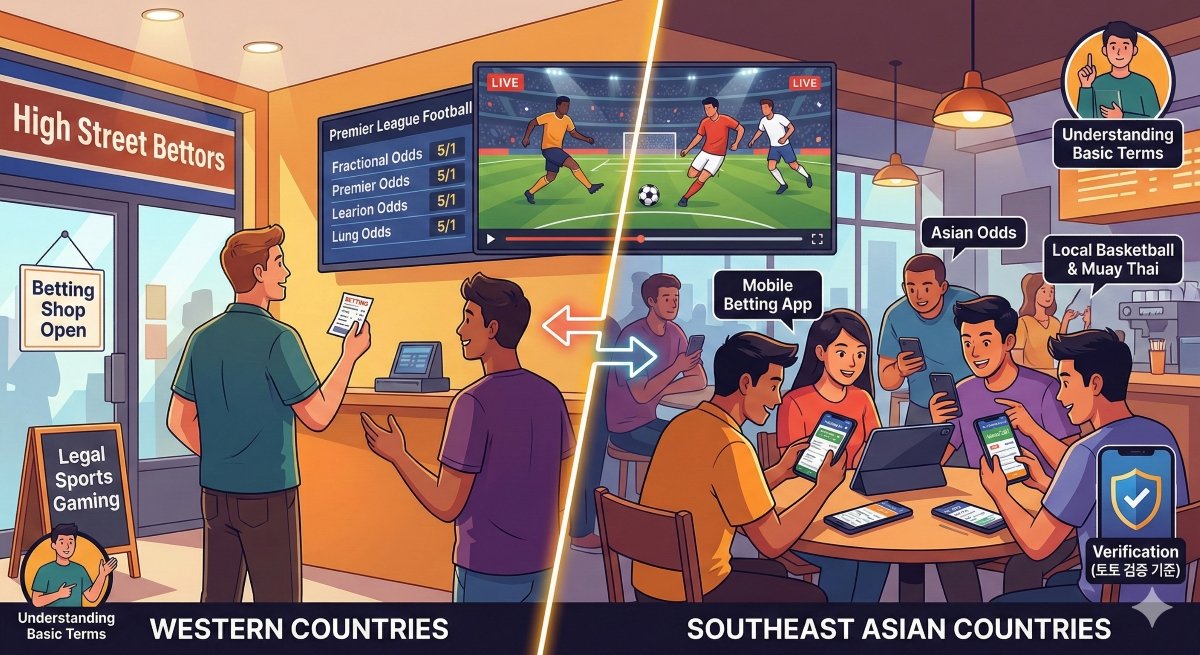
The biggest difference between these two regions is how the law treats betting. In the West, particularly in countries like the UK, sports betting is a highly regulated and open industry. It is seen as a normal form of entertainment. You can find betting shops on the street, and commercials for gaming apps are common on television.

In Southeast Asia, the situation is much more complex. Many countries in this region have strict laws against most forms of gambling due to religious or cultural reasons. However, because the passion for sports is so high, many people still find ways to participate. In some places, like the Philippines, there are official government-regulated outlets, while in others, the activity happens in a more private or unofficial way. This means that while Westerners might talk about their bets openly with friends, people in Southeast Asia are often more private about it.

Popular Sports: Global Stars and Local Favorites

The sports that draw the most attention are also quite different. In the West, especially in Europe, football (soccer) is the number one sport for bettors. In the United States, American football, basketball, and baseball dominate the scene. These fans focus heavily on their local professional leagues, like the Premier League or the NBA.

In Southeast Asia, the love for European football is also incredibly strong. Millions of fans in countries like Thailand and Indonesia follow English and Spanish teams with great passion. However, there are also unique local interests. For example, in the Philippines, basketball is almost like a religion, and it attracts a massive amount of attention. In other parts of the region, combat sports like Muay Thai or even traditional events are very popular. This mix of global and local sports creates a very vibrant and diverse culture.

How People Play: Retail Shops vs. Mobile Technology

The way people place their bets has evolved differently in each region. In the West, there is a long history of “retail” betting. For decades, British people have visited physical shops to place their wagers. While mobile apps are now the most popular choice, those physical shops remain a part of the local culture.

In Southeast Asia, many communities “skipped” the era of physical shops and went straight to mobile phones. Because almost everyone has a smartphone, digital platforms are the primary way people connect with sports. In these countries, community is very important. You might see a group of friends watching a game together in a cafe, all checking their phones and discussing the match in real-time. This makes the experience very social and connected, even if it is done through a digital screen.

Understanding the Systems: Fractional, Decimal, and Local Odds

The “language” of betting is another area where these cultures diverge. If you are new to this, it is helpful to use a Sports Betting Glossary: Essential Guide for Beginners to learn the basic terms.

Western countries often use Fractional odds (like 5/1) or Decimal odds (like 6.00). These are standardized and easy to find on any major international website. In Southeast Asia, you might encounter these international formats, but you also see local systems that have been used for generations. These local systems are often designed for quick calculations among friends and might look quite different to a visitor from the West.

Trust and Safety: The Role of Verification

Because the legal landscape in Southeast Asia can be complicated, safety is a major concern for players. In the West, players trust that a site is safe because it has a government license. In Southeast Asia, players have to be much more careful. They often rely on community recommendations and specific “verification” steps to make sure a platform is honest.

For users interested in understanding how Verification Sites works in real cases, it is important to know that these rules are used to check if a site is reliable. This process of “verification” is a huge part of the culture in Asian countries, as it helps players avoid scams and find a safe place to enjoy their hobby.

While the West and Southeast Asia have different rules and traditions, the heart of the activity is the same: the excitement of the game. Western culture is more about open regulation and traditional shops, while Southeast Asian culture is built on a mix of global passion, mobile technology, and community trust. As the world becomes more connected, these two cultures are starting to influence each other, leading to a future where sports fans everywhere can share in the excitement of the win.