

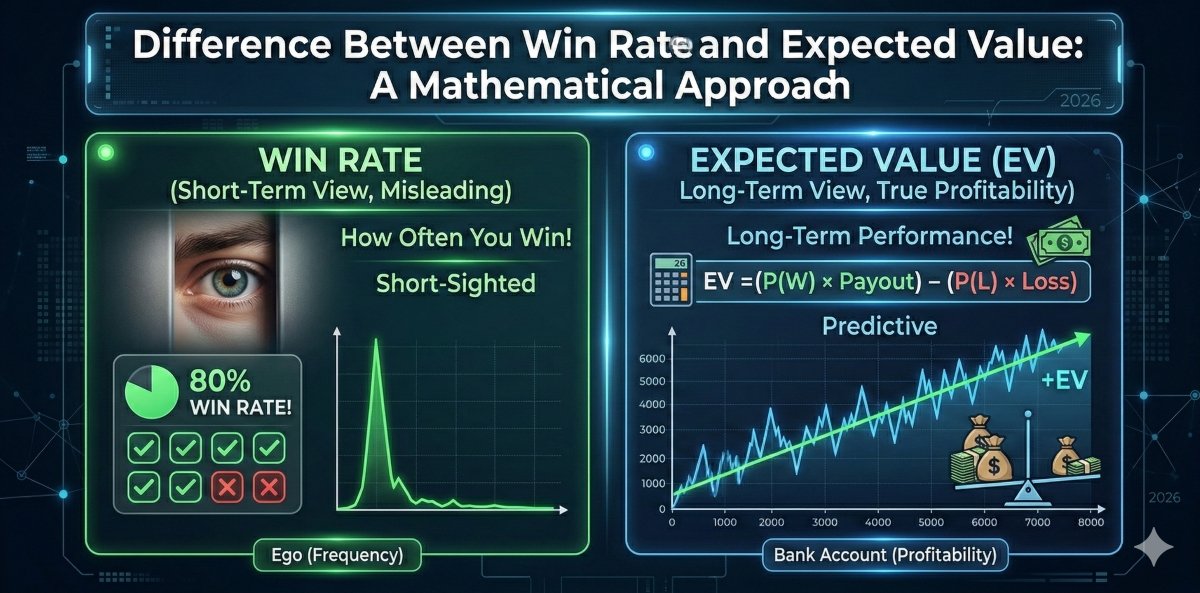
In the world of sports betting and financial investments, people often focus on one question: “How often do I win?” This percentage is known as the Win Rate. While a high win rate feels good, it does not actually tell a person if they are making money. To understand true success, a person must look at a different metric: Expected Value (EV).
While win rate measures frequency, Expected Value measures profitability over the long term. Understanding the mathematical relationship between these two concepts is the difference between a casual fan and a professional analyst.
What is Win Rate?
Win rate is the simplest way to track performance. It is calculated by taking the number of successful outcomes and dividing them by the total number of attempts.
$$Win\ Rate = \frac{Successful\ Outcomes}{Total\ Attempts} \times 100$$
If a bettor places 100 bets on football matches and wins 60 of them, their win rate is 60%. On the surface, this looks like a great result. However, win rate is a “blind” metric. It does not account for the “price” or the odds of those wins. A person could have a 90% win rate and still lose money if their few losses are much larger than their many small wins.
Defining Expected Value (EV)
Expected Value is a more advanced mathematical concept. It represents the average amount a person can expect to win or lose per bet if they were to place the same bet thousands of times. It combines the probability of winning with the potential payout and the probability of losing with the potential loss.
The formula for Expected Value is:
$$EV = (Probability\ of\ Winning \times Amount\ Won\ per\ Bet) – (Probability\ of\ Losing \times Amount\ Lost\ per\ Bet)$$
When the result of this calculation is a positive number, it is called +EV. This means that, mathematically, the bet is profitable in the long run. If the result is negative, or -EV, the person will eventually lose money, regardless of how high their win rate is.
Why a High Win Rate Can Be Misleading
To illustrate the difference, consider two different bettors.
Bettor A focuses on “safe” bets with very low odds. They win 80% of the time. However, because the odds are so low, they only win $10 for every $100 they bet. When they lose, they lose the full $100.
Using the EV formula for Bettor A:
$$EV = (0.80 \times \$10) – (0.20 \times \$100)$$
$$EV = \$8 – \$20 = -\$12$$
Even though Bettor A wins almost every time, they lose an average of $12 every time they play. Their high win rate is a trap.
Bettor B takes more risks. They only win 40% of the time. However, they only place bets where the payout is $200 for every $100 bet.
Using the EV formula for Bettor B:
$$EV = (0.40 \times \$200) – (0.60 \times \$100)$$
$$EV = \$80 – \$60 = +\$20$$
Bettor B loses more often than they win, but they are mathematically guaranteed to make a profit over a long period. This is why professionals prioritize EV over win rate.
The Role of Probability and Variance
In 2026, technology allows analysts to calculate “True Probability” more accurately. This is the actual chance of an event happening, stripped of the bookmaker’s fees. To find a +EV opportunity, a person must find a situation where their calculated probability is higher than the probability suggested by the bookmaker’s odds.
This leads to the concept of Variance. Variance is the “noise” or the ups and downs that happen in the short term. A +EV bettor might lose ten times in a row. This is frustrating, but the math does not change. If the Expected Value is positive, the “law of large numbers” states that the actual results will eventually align with the mathematical expectation.
[Image of statistical variance graph]
How Professional Platforms Use EV
Modern “Toto” sites and international sportsbooks use complex algorithms to ensure their odds stay in the -EV range for the average player. They do this by adding a “margin” or “vig.”
For example, in a perfectly fair coin flip, the odds should be 2.00. If a bookmaker offers 1.90 for both heads and tails, they have created a -EV situation for the bettor.
$$EV = (0.50 \times \$90) – (0.50 \times \$100)$$
$$EV = \$45 – \$50 = -\$5$$
In this scenario, even with a 50% win rate, the player loses $5 per bet. Professional bettors look for “soft” lines where the bookmaker has made a mistake, allowing the player to flip the math back into a +EV position.
Building a Strategy Based on Math
To move from a casual player to a disciplined analyst, a person must change their mindset. Instead of asking “Who will win this game?”, they should ask “Are the odds offering a higher payout than the actual risk?”
- Track Every Move: Keep a detailed log of every bet, the odds, and the closing lines.
- Focus on Value, Not Teams: A person might hate a specific team, but if the odds are high enough to create +EV, the math says they should place the bet.
- Manage the Bankroll: Because +EV strategies often involve lower win rates, it is vital to have enough money to survive the losing streaks (variance).
The Well-Being of the Mind
Understanding these numbers also helps with mental health. When a person realizes that a loss is just a part of mathematical variance, they feel less stress. They stop “chasing losses” because they know that as long as they keep placing +EV bets, the money will eventually return.
In the 2026 gaming landscape, the most successful individuals are those who treat the screen like a calculator rather than a crystal ball. Win rate is for the ego, but Expected Value is for the bank account.