

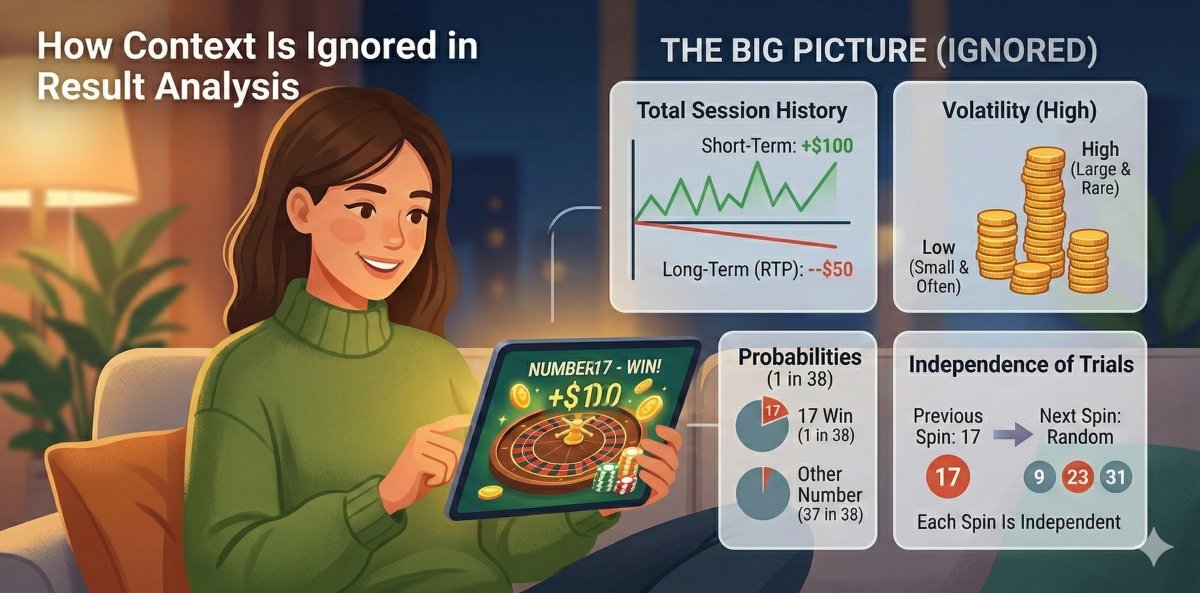
When we look at the results of a game in an online casino, we often see a simple number or a win/loss message. It is very easy to look at that outcome and think we understand exactly what happened. However, a major mistake many beginners make is ignoring the “context” behind the result. In gambling, the environment and the math that created the result are just as important as the result itself.
The Problem with Looking Only at the End
Imagine two players, Sarah and Mark. Sarah bets $10 on a single number in roulette and wins $350. Mark bets $10 on “Red” and wins $10. If we only look at the final numbers, Sarah looks like the much more successful player.
However, if we add context, the story changes. Sarah took a massive risk with a very low probability of winning. Mark took a much smaller risk with a nearly 50% chance of winning. If they both play 100 more rounds with the same strategy, the context of the game’s odds tells us that Sarah is likely to lose her winnings quickly, while Mark’s balance will likely be more stable. When we ignore context, we mistake a lucky gamble for a superior strategy.
Short-Term Luck vs. Long-Term Reality
The biggest piece of context in any casino game is time. Beginners often analyze their results based on a single afternoon of playing. If they win $100 in two hours, they believe their “system” is working perfectly.
In reality, the context of that win is just a tiny blip in a much larger sequence. Every licensed game has a “Return to Player” (RTP) percentage. For example, if a slot has a 96% RTP, the context is that for every $100 bet over millions of spins, the machine is designed to pay back $96. Winning $100 in ten minutes is a result that ignores the context of the millions of other spins happening across the network. Without the context of the RTP, a beginner might think they have found a way to beat the machine forever.
The Role of Volatility
Context also includes how a game is designed to pay out. This is called volatility. Some games pay out small amounts very often (low volatility), while others pay out huge amounts very rarely (high volatility).
If a beginner plays a high-volatility slot machine and doesn’t win anything for twenty spins, they might think the game is “broken” or “unfair.” If they had looked at the context of the game’s volatility, they would understand that long dry spells are a normal part of how that specific game works. By ignoring this context, players often get frustrated or quit a game right before the math would have naturally balanced out, or they stay too long in a game that doesn’t fit their budget.
Emotional Context and Decision Making
We often analyze our wins and losses when we are in a high emotional state. If you are on a winning streak, you might feel invincible. If you are losing, you might feel desperate. This emotional “context” heavily influences how we see our results.
When we are winning, we ignore the context of how much we have already spent to get that win. We might see a $50 win and feel great, even if we spent $70 to get it. Our brain ignores the context of the net loss because it is focused on the excitement of the “win” notification. Analyzing results without looking at your total bankroll history is like reading a book by only looking at the last page; you miss the whole story of how you got there.
The Illusion of “Hot” and “Cold”
In many online casinos, you will see a list of “hot” or “cold” numbers in games like roulette or baccarat. Beginners often use this as their main analysis tool. They think, “Number 17 hasn’t come up in an hour, so it’s due to hit.”
The missing context here is the independence of trials. In a fair, digital casino game, the computer doesn’t “remember” what happened in the last round. The context of every single spin is that it is 100% independent. The fact that a number hasn’t appeared recently has zero impact on the probability of it appearing next. When players ignore this scientific context, they start chasing results that aren’t based on reality.
How to Better Analyze Your Results
To avoid the trap of ignoring context, try to look at your play sessions as a whole. Instead of asking “Did I win this round?”, ask yourself these questions:
What were the mathematical odds of that win happening?
How much did I have to bet in total to achieve that result?
Does this game have high or low volatility?
Am I making this decision based on data or because I feel “lucky”?
By adding these layers of context, you move away from emotional guesswork and toward a more mature understanding of how gambling works.
Final Thoughts for Beginners
The result of a game is just a data point. The context—the odds, the volatility, the bankroll, and the independence of the game—is the actual information. Beginners who learn to look at the “why” and “how” behind a win or loss are much better equipped to manage their money and have a sustainable, fun experience. Remember, the house edge is always there as a constant context, so the best way to “win” is to treat every session as a paid form of entertainment rather than a predictable puzzle to solve.